Let's be honest: the first time most veterans heard 'MDMA therapy,' the reaction was some version of 'they want to give veterans molly?' The skepticism is understandable. The military community has a complicated relationship with mental health treatment, and anything that sounds experimental — or that carries a Schedule I stigma — is going to generate pushback. But the science on this one deserves a fair read.
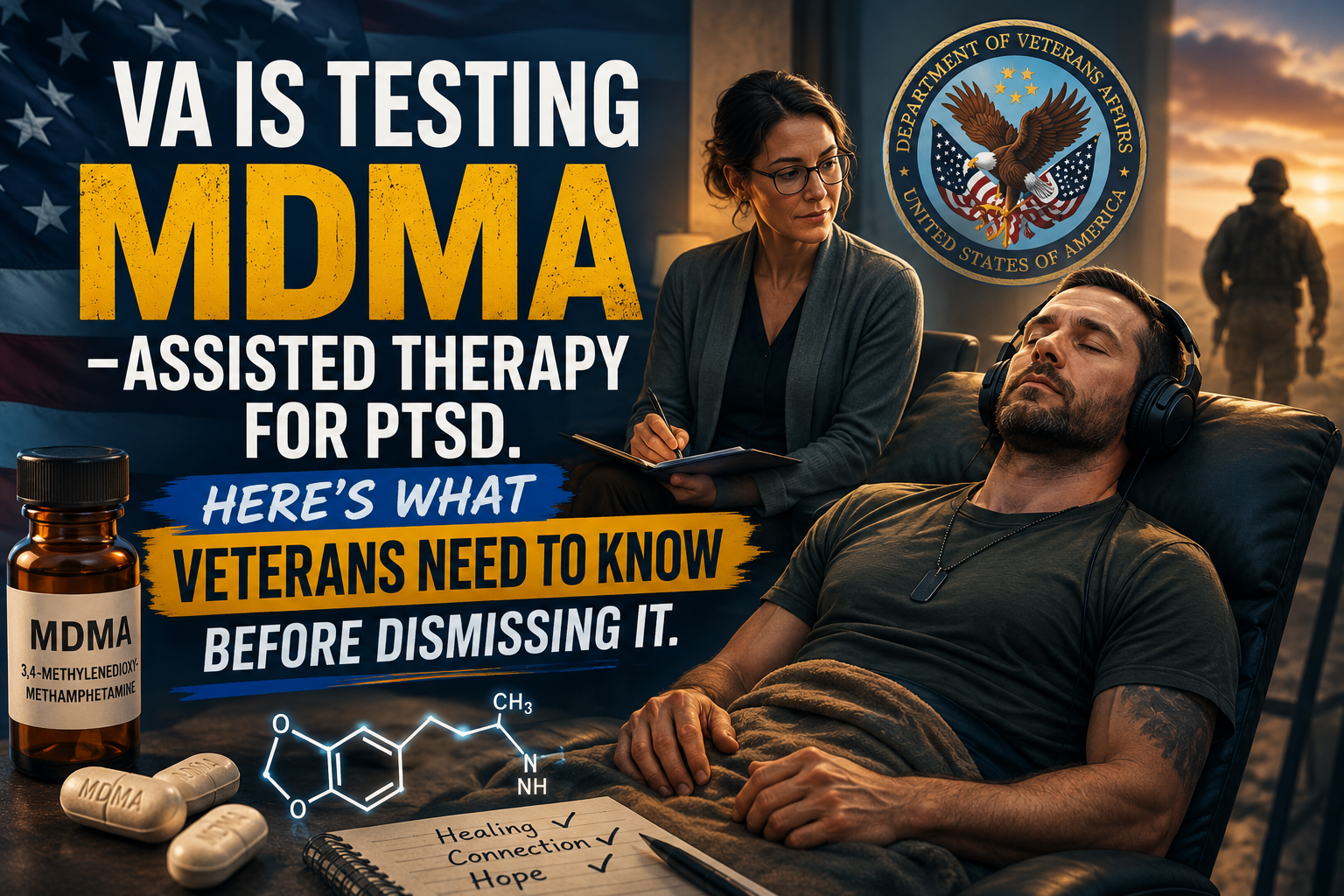
In 2026, the Department of Veterans Affairs launched a new clinical trial to evaluate the safety and efficacy of MDMA-assisted therapy for severe mental health disorders — specifically posttraumatic stress disorder and alcohol use disorder. This is not a fringe program. It's a peer-reviewed, IRB-approved clinical trial built on a decade of research that the veteran community's mental health advocates have been pushing VA to engage with for years.
What MDMA-Assisted Therapy Actually Is
MDMA-assisted therapy is not recreational drug use. It's a structured clinical protocol in which a specific dose of MDMA is administered in a controlled therapeutic setting, with trained therapists present, as a component of an extended trauma-processing session. The MDMA is a tool — not the therapy itself.
The mechanism, as researchers understand it, involves a reduction in the fear response and an increase in feelings of trust and openness, which allows patients to engage with traumatic memories in a way that would otherwise be impossible without being overwhelmed. Multiple Phase 2 trials have shown significant reductions in PTSD severity — in some cases, remission — in participants who had previously not responded to conventional treatment.
Why This Matters for the Veteran Community
Veterans are disproportionately represented in the populations for whom conventional PTSD treatment fails. SSRIs, prolonged exposure therapy, CPT — these work for a significant percentage of patients. They don't work for everyone. And for the veterans who've been through multiple treatment modalities without lasting relief, the question of what comes next is not academic. It's survival.
The VA's decision to run this trial is meaningful because it signals institutional willingness to take seriously a treatment approach that has been advocated by veteran-focused nonprofit organizations — including MAPS (Multidisciplinary Association for Psychedelic Studies) — for years, often in the face of institutional resistance.
What Veterans Should Know If They're Interested
-
This is a clinical trial — participation is voluntary and subject to eligibility criteria. Not everyone will qualify.
-
Participants must have a diagnosed PTSD or alcohol use disorder and typically have a history of treatment non-response.
-
The trial is VA-supervised and conducted by trained therapists. This is not a DIY situation.
-
Any veteran interested in participating should talk to their VA mental health provider and ask specifically about MDMA-assisted therapy trial enrollment.
-
The trial results will take time — but preliminary data from earlier non-VA trials is available through published literature that your provider can access.
The Stigma Conversation
Here's the part that no one talks about in official VA communications: the stigma barrier for this treatment is enormous in the military community, and it goes beyond the drug association. Veterans who struggle to admit they have PTSD in the first place are not well-positioned to ask their command climate about whether MDMA therapy is an option.
If you're active duty and reading this, know: clinical trial participation is a protected medical activity. Your mental health treatment — including trial enrollment — is not subject to command disclosure requirements, with narrow exceptions. Talk to your healthcare provider. The chain of command doesn't need to know.
Join the Conversation
Have you tried conventional PTSD treatment without the results you needed? Are you watching this trial with interest or skepticism? The veteran community needs honest conversations about what works and what doesn't — drop your perspective below.