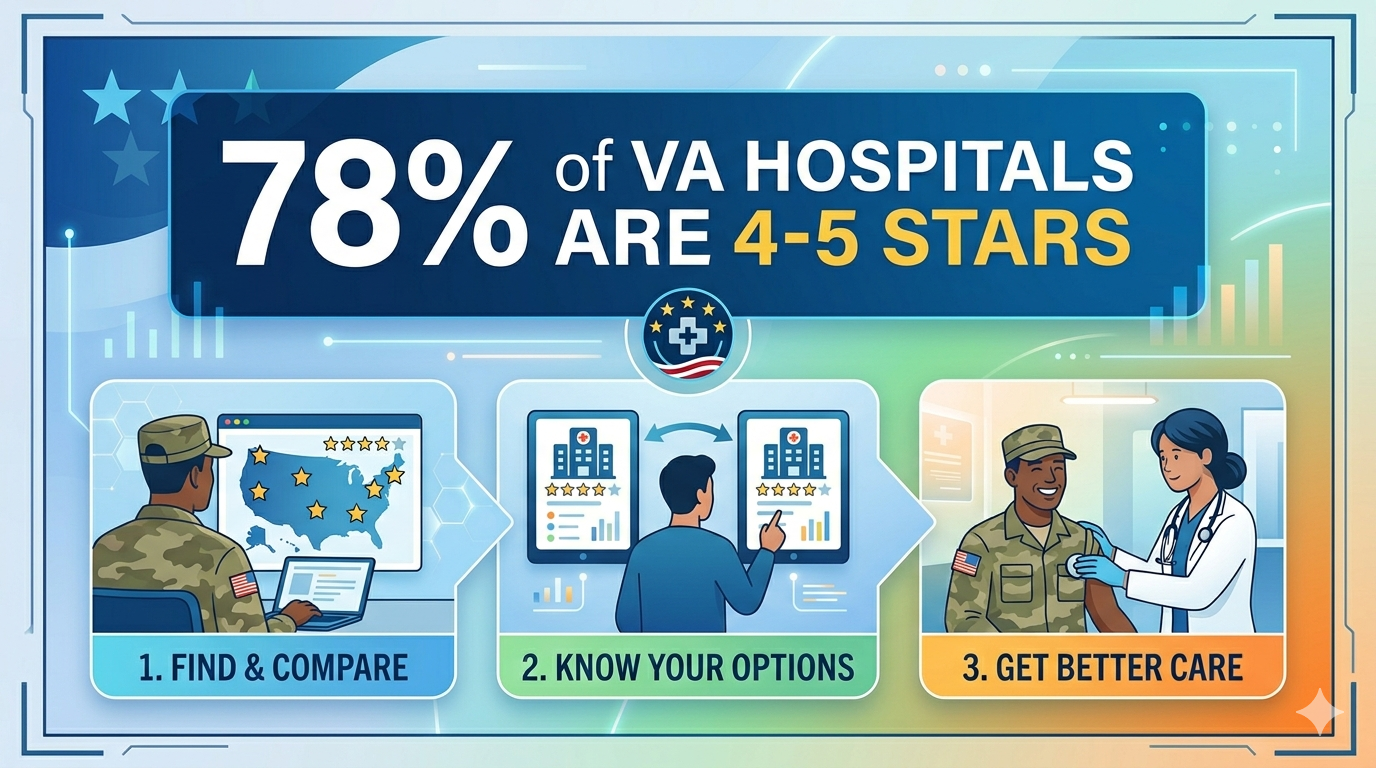
Here's a conversation most veterans have never had with their VA provider: 'How does this facility compare to other VA medical centers for the condition I'm dealing with?' Most of us show up, check in, wait, see the provider, and leave. We don't think of VA healthcare as a system we can navigate strategically. But the data exists to do exactly that — and 78% of VA hospitals earning four or five stars in 2026 means there's meaningful quality to find if you know where to look.
The Department of Veterans Affairs announced in May 2026 that 78% of VA hospitals receiving an Overall Hospital Quality Star Rating from the Centers for Medicare & Medicaid Services earned four or five stars — the agency's highest performance tier. That's a significant statistic that deserves to be understood, not just celebrated.
What the Star Rating Actually Measures
The CMS Overall Hospital Quality Star Rating pulls together data across five domains: Mortality, Safety of Care, Readmission, Patient Experience, and Timely & Effective Care. Each domain is weighted and combined into an overall star rating from one to five. A five-star rating doesn't mean perfection — it means the facility performs in the top tier across these measures relative to its comparison group.
Importantly, VA hospitals are rated on the same system as private hospitals. This is one of the few apples-to-apples comparisons available between VA care and the broader healthcare market. When 78% of VA facilities are in the top tier, that's not a self-reported VA metric — it's an independent CMS assessment.
How to Use This Data to Navigate Your Care
-
Look up your specific VA medical center's star rating on the CMS Care Compare website (medicare.gov/care-compare) — this is public data.
-
If your facility is a 3-star or below, understand that you may have access to community care options under the Mission Act — ask your VA patient advocate about eligibility.
-
For specialty care, look at condition-specific quality measures rather than the overall star rating — a 4-star hospital may have a 5-star cardiac program and a 3-star orthopedics program.
-
Use the VA's MISSION Act community care criteria as leverage: if VA cannot provide care within access standards (20-minute drive for primary care, 60 minutes for specialty care, or 20-28 day wait times), you're entitled to community care.
-
Request your medical records and maintain your own health file — this is especially important if you receive care at multiple facilities or transition between VA and community care.
What the 22% Represents
Twenty-two percent of VA hospitals that received star ratings earned fewer than four stars. That's not a rounding error. For veterans assigned to lower-performing facilities, the star rating system isn't just an academic data point — it's actionable information about whether community care options should be explored.
The geographic reality is that some lower-rated facilities serve veteran populations with limited alternatives — rural areas, remote communities, or VISNs with limited provider options. For those veterans, the conversation is less about navigating to a better facility and more about advocating for improvement at their local center.
The VA Health and Benefits App — Use It
VA's mobile app puts appointment scheduling, prescription management, secure messaging with your care team, and benefits status all in one place. If you're not using it, you're adding friction to an already complex system unnecessarily. Download it. Set it up. The app doesn't fix a bad facility rating, but it removes the administrative barriers that make even good facilities harder to use.
Advocating for Quality Improvement
The star rating system works partly because it creates accountability. VA facilities that score poorly are subject to congressional scrutiny, OIG review, and public attention. Veterans who share their quality experiences — good and bad — through VA satisfaction surveys, VA feedback systems, and public discourse contribute to the data that drives accountability.
Your experience with VA is not just personal. It's a data point that affects how the system evolves. Use your voice.
Join the Conversation
Have you researched your VA facility's quality ratings? Did it change how you navigate your care? Share your approach — practical tips from veterans who've worked the system are more valuable than any official VA guide.