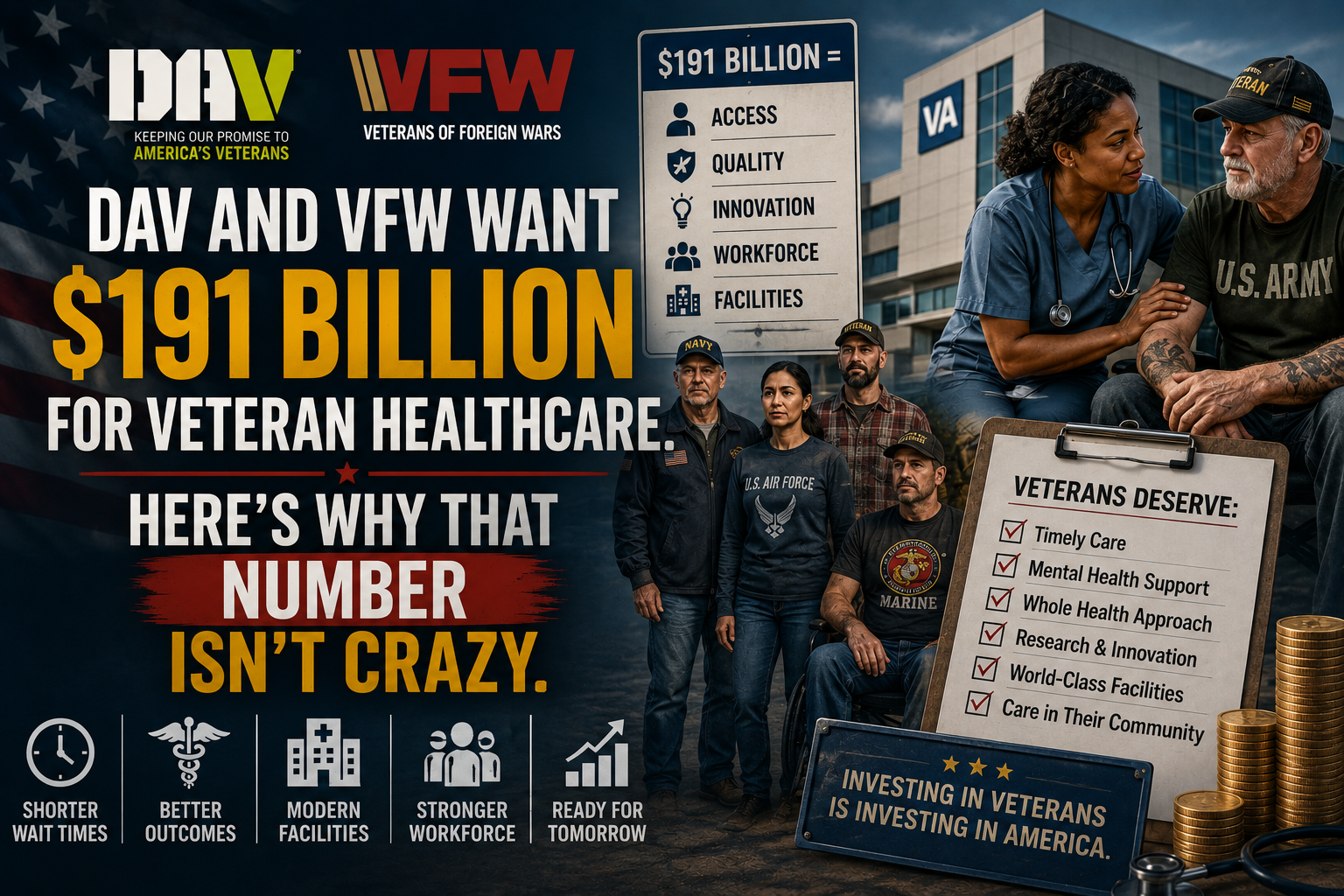
Pull up any veteran community forum and you'll find two competing narratives: one that says the VA is an irredeemable bureaucratic disaster, and one that says it's a critical lifeline that serves millions of veterans who have nowhere else to go. Both narratives contain truth. But neither one explains why the DAV and VFW are recommending Congress appropriate $191.5 billion for the Veterans Health Administration in FY2027 — a 13% increase over FY2026.
The number sounds enormous. It is enormous. But when you understand what's driving it, it starts to look less like a budget wish list and more like a basic math problem.
Why the Number Is Going Up
Three forces are colliding in the VA healthcare system simultaneously — and each one alone would justify increased funding. Together, they create a demand surge the system wasn't built to handle.
First: The PACT Act. The 2022 legislation expanded VA eligibility to hundreds of thousands of veterans who were previously denied because their toxic exposure conditions weren't recognized as service-connected. Those veterans are now in the system, using VA healthcare, and they came with complex, expensive conditions — cancers, respiratory diseases, neurological disorders that are often expensive to treat and manage long-term.
Second: The veteran population is aging. Vietnam-era veterans — one of the largest cohorts in VA history — are entering the highest healthcare utilization years of their lives. Geriatric care, long-term care, hospice, and end-of-life support are all significantly more expensive than routine primary care.
Third: Healthcare inflation. The same cost pressures affecting the commercial healthcare market — staffing costs, pharmaceutical prices, medical technology — apply to VA. A system that serves approximately 9 million veteran patients cannot escape the broader economic environment.
What the VSOs Are Actually Asking For
-
Approximately $191.5 billion in total VHA resources — mandatory and discretionary combined.
-
Investment in long-term care capacity to handle the aging Vietnam-era veteran population.
-
Dental care expansion — a persistent gap in VA coverage that affects veteran quality of life and overall health outcomes.
-
Urgent and emergency care improvements, including reduced reliance on cost-shifting to community care.
-
Enhanced VA-DoD collaboration on military transition healthcare continuity.
-
$3.6 billion for Major Construction and $5.1 billion for Minor Construction to begin closing the $170 billion infrastructure gap.
The Political Reality
Congress isn't going to appropriate $191.5 billion for VA healthcare without a fight. The VSO recommendations represent what the system needs; what it gets is a function of political will, budget scoring, and the competing demands of a defense budget strained by active military operations.
This is where the veteran community's political engagement matters. VSOs have maintained a consistent advocacy presence that has delivered results — the PACT Act, the Mission Act, the VA MISSION improvements were all driven in part by organized veteran advocacy. The FY2027 budget fight is the next front in that battle.
What Veterans Can Do
-
Contact your congressional representative — both House and Senate. Constituent contacts on VA funding make a measurable difference.
-
Join your VSO chapter and participate in their legislative advocacy activities. DAV, VFW, American Legion, and others have formal advocacy programs with direct congressional access.
-
Share your personal VA healthcare experience with elected officials — personal testimony from constituents is more powerful than statistics.
-
Track VA budget legislation through the House and Senate Veterans' Affairs Committees — both publish hearing schedules and bill status updates.
Join the Conversation
Do you rely on VA healthcare? Have you experienced the access or capacity challenges that these funding increases are designed to address? Share your story — because the human reality behind budget numbers is what moves legislators to act.