You've been to a VA facility with asbestos ceiling tiles. You've used a VA bathroom with pipes that rattle, in a building that was constructed during the Korean War era. You've sat in a waiting room with chairs older than your service record. And you've probably wondered: where exactly is the money going?
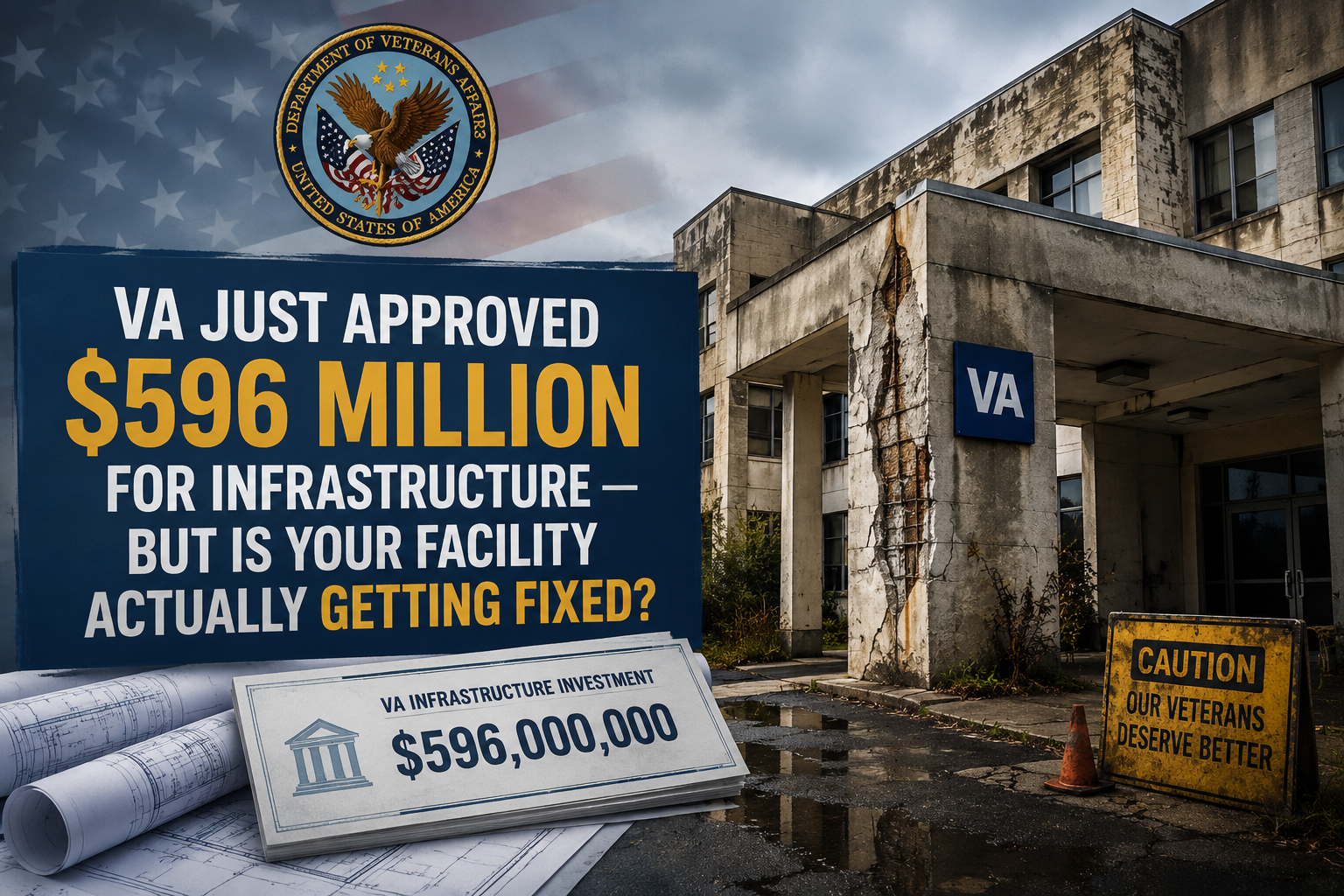
In May 2026, the Department of Veterans Affairs announced it approved $596 million in infrastructure improvements in the second quarter of fiscal year 2026 alone. That's part of a record $4.8 billion the VA plans to deploy this year in non-recurring maintenance funds — the largest infrastructure investment the department has made in modern history. This is real money. The question is whether it translates to real improvements at the facilities veterans actually use.
Why VA Facilities Got This Bad
VA's infrastructure problem didn't happen overnight. The department manages more than 6,250 buildings, most supporting health care. Its 10-year capital needs have surged from $40 billion in FY2016 to over $170 billion in FY2026. That gap — between what the system needs and what Congress appropriates — has been growing for decades.
The result is a health care system delivering 21st-century clinical care in, in some cases, mid-20th century physical plants. The mismatch matters — not just for comfort but for clinical quality, infection control, patient safety, and the ability to recruit and retain medical staff who have other options.
What the $596 Million Actually Covers
Non-recurring maintenance (NRM) funding is the VA's mechanism for addressing deferred maintenance — roof replacements, HVAC system overhauls, electrical upgrades, plumbing, accessibility improvements, and structural repairs. It's the opposite of glamorous. It's the infrastructure work that keeps buildings functional and safe, not the expansion projects that get ribbon-cutting ceremonies.
-
Electrical system upgrades at aging medical centers — critical for modern diagnostic equipment.
-
HVAC replacements — directly tied to infection control standards and patient safety.
-
Accessibility improvements — ADA compliance gaps at older VA facilities affect veterans with mobility limitations.
-
Roof and structural repairs — deferred for years at dozens of facilities across the country.
-
Plumbing system overhauls — particularly urgent at facilities with aging infrastructure in cold-weather climates.
How to Find Out If Your VA Medical Center Is Getting Funding
The VA publishes its capital planning documents and budget justifications. These aren't always easy to navigate, but they are public. Here's how to find out what's happening at your facility:
-
Visit the VA's Office of Construction and Facilities Management website and look for your VISN (Veterans Integrated Service Network) region's capital project list.
-
Attend your local VA medical center's Community Based Outreach Clinic (CBOC) advisory board meetings — these are open to veterans and cover facility planning.
-
Contact your VSO (Veterans Service Organization) chapter. DAV, VFW, and American Legion representatives are plugged into VA planning processes.
-
File a congressional inquiry through your representative's office if you have a specific unaddressed facility concern — Congress takes constituent complaints about VA facilities seriously.
-
Use VA's feedback mechanism (feedback.va.gov) to formally document facility condition concerns.
The Trust Numbers Tell a Story
VA recently reported that 82% of veterans who used VA services in Q1 of FY2026 said they trust the VA to fulfill the nation's commitment to them — an all-time high. That's a meaningful number, and it reflects real improvements in access, quality, and responsiveness over the past several years.
But trust is built and sustained on consistent delivery. An 82% trust figure is a baseline, not a guarantee. The infrastructure investment is a necessary step toward sustaining that trust — because there is nothing that erodes confidence in a health care system faster than visibly deteriorating facilities.
Join the Conversation
What's the condition of your local VA facility? Have you seen improvements — or are you still fighting for basic maintenance that should have happened years ago? Share your experience. Veterans holding VA accountable through public discourse is one of the most effective accountability mechanisms we have.