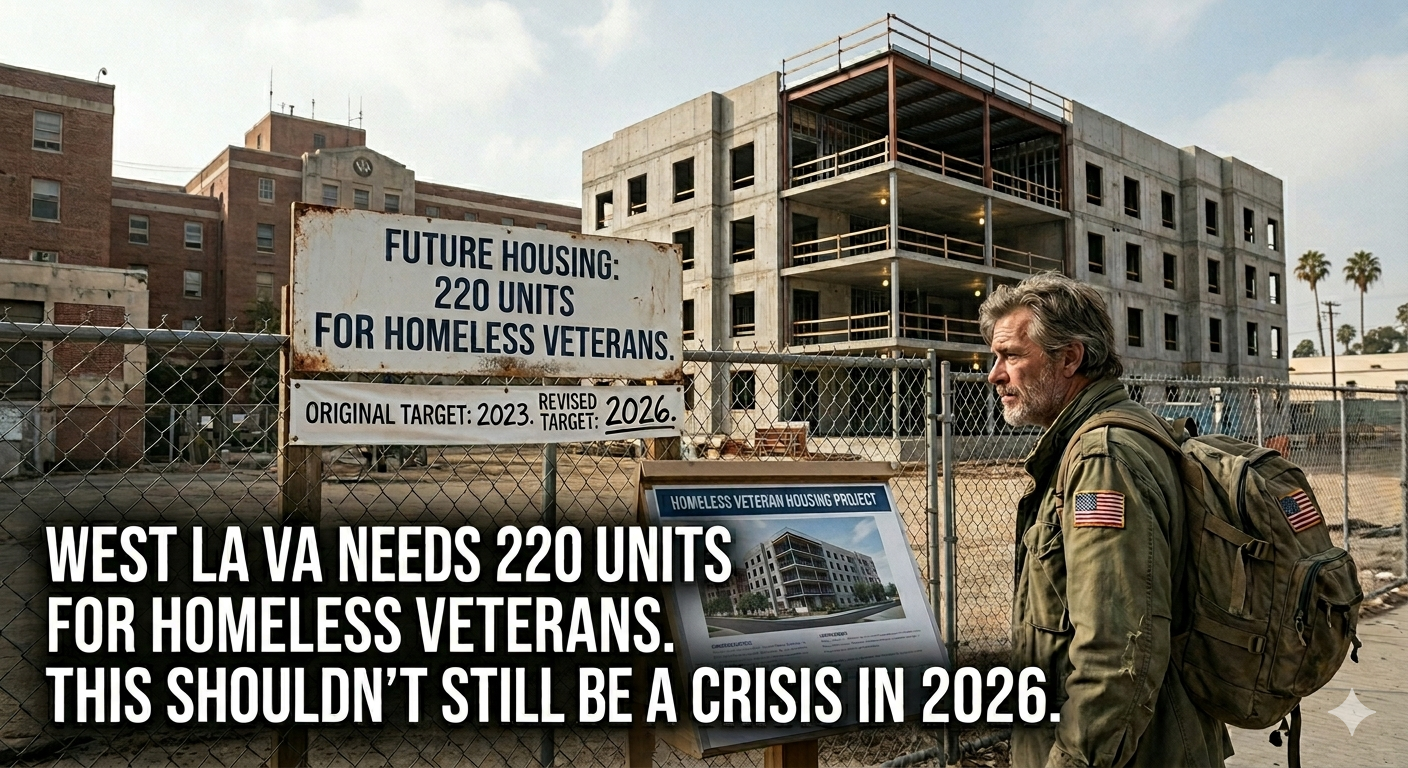
The United States spends more on defense than the next ten countries combined. We have 11 carrier strike groups, a nuclear triad, and the most technologically advanced military in human history. And in 2026, the Department of Veterans Affairs issued a request for proposals to build 220 temporary housing units for homeless veterans at the West Los Angeles VA Medical Center.
Let that sit for a second. Temporary. Housing. For veterans living on the street near a VA medical campus.
Veteran homelessness is one of the most persistent failures of the United States' commitment to its military community. Despite years of progress, program funding, and sincere effort from VA and nonprofits alike, veterans remain significantly overrepresented among the unhoused population relative to their share of the general population. And the West LA campus — one of the largest VA properties in the country — has been at the center of a legal and advocacy battle over its use for veteran housing for more than a decade.
The West LA VA Story
The West LA VA Medical Center sits on 388 acres of prime Los Angeles real estate that was deeded to the federal government in 1888 with an explicit requirement that it be used for the care of disabled veterans. For decades, the VA leased portions of that land to non-veteran entities — a private school, a hotel, a car rental company, a baseball diamond — while veterans slept on the streets of Los Angeles.
A 2015 federal court settlement ended most of those leases and required VA to develop a master plan for using the campus for veteran housing and services. Progress has been slow. The 220 temporary units VA is now soliciting are a meaningful step, but 'meaningful step' and 'adequate response' are not the same thing.
Who Are the Veterans Living Without Housing in LA
Los Angeles County has the largest population of unhoused veterans in the country — estimates range from 3,000 to over 4,000, depending on methodology and the time of year. These are not exclusively young veterans from recent conflicts. The veteran homeless population spans generations: Vietnam-era veterans dealing with decades of untreated PTSD and substance use, Gulf War veterans, Iraq and Afghanistan veterans in their 30s and 40s who couldn't navigate the transition.
The common thread isn't age or era. It's a breakdown somewhere in the support system — mental health, substance use, a financial crisis at the wrong moment, a family that couldn't hold together, a benefits system that was too hard to navigate. The average distance between a stable discharge and a street isn't as long as most people think.
What the Community Can Do
-
Connect with national veteran housing nonprofits: New Directions, National Coalition for Homeless Veterans, and Operation Gratitude all have active programs.
-
If you're in the LA area, volunteer with Stand Down LA or other local veteran housing events that provide direct services.
-
Donate specifically to veteran housing programs — not general VA support funds — if you want to make sure your contribution addresses this crisis.
-
Contact your congressional representative and specifically ask about the West LA VA master plan implementation timeline.
-
If you know a veteran who is housing-insecure, connect them with VA's National Call Center for Homeless Veterans: 1-877-4AID-VET (1-877-424-3838).
The Moral Weight
There is no version of 'fulfilling the nation's promise to its veterans' that includes allowing veterans to sleep on streets within sight of a VA campus. The 220 temporary units are progress. They are not a solution. The solution requires permanent housing, sustained wrap-around services, and the kind of institutional commitment that doesn't reset with every budget cycle or administration change.
Veterans who've made it through the system — with stable housing, income, and support — have an obligation to the ones who haven't. That obligation is personal and community-level, not just governmental.
Join the Conversation
Do you have experience with veteran homelessness — as someone who's lived it, as a volunteer, as a service provider? Share your story. The path from a DD-214 to a street isn't inevitable. Understanding how it happens is the first step to preventing it.