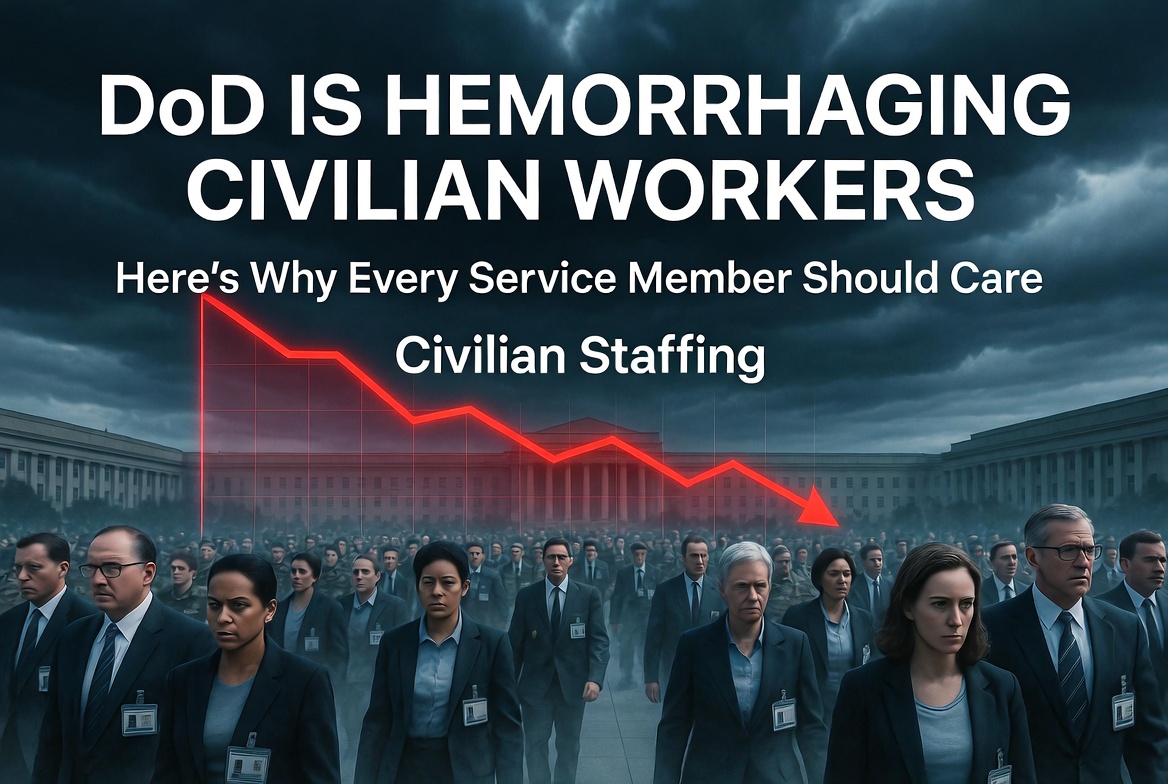
You walk into your post's housing office to resolve a BAH discrepancy. The wait is three weeks for an appointment. The contractor who used to handle it is gone. The GS employee who knew the system is gone. The person sitting at the desk now is new, undertrained, and overwhelmed. Sound familiar? That's not an isolated experience — it's becoming the norm across DoD installations nationwide.
The federal workforce reductions that swept through the government in early 2026 — driven by the administration's DOGE initiative — have hit the Department of Defense harder than most civilians realize. Thousands of DoD civilian employees have departed through deferred resignation programs, RIFs, and voluntary separations. The result is an installation support system running on fumes.
What Civilian Workers Actually Do On Your Installation
The military community tends to undervalue DoD civilians — right up until they're gone. These are the people who run your legal assistance office, manage TRICARE enrollment, process PCS vouchers, staff the post exchange and commissary management teams, maintain installation records, run the childcare centers, and keep the contracting shop moving.
They are not overhead. They are the connective tissue that lets service members focus on warfighting. When that connective tissue tears, the effects cascade in ways that are hard to see at first — and then suddenly impossible to ignore.
-
Finance and pay support delays affect cash flow for junior enlisted families already living paycheck to paycheck.
-
Legal assistance shortfalls leave service members without support on issues ranging from landlord disputes to estate planning before deployment.
-
Maintenance and facilities staffing gaps mean broken equipment stays broken longer — affecting quality of life and sometimes safety.
-
Childcare center staffing reductions force military spouses to choose between working and childcare — compounding financial stress.
-
Contracting delays slow the acquisition of everything from training ammunition to vehicle parts.
The Congressional Warning Signal
Members of the House Appropriations Committee have begun raising alarms about what these workforce losses mean for installation operations. The concern isn't abstract — it's rooted in what committees are hearing from installation commanders and family readiness groups: services are degrading, response times are lengthening, and the people who kept the lights on are leaving.
For service members, this is a readiness issue masquerading as an administrative inconvenience. When your unit is preparing for deployment and the support functions that should be working seamlessly are stretched thin, the friction accumulates. Time spent chasing paperwork, fighting incorrect pay, or navigating a system without adequate support is time not spent training.
What You Can Do When the System Is Stretched
Complaining to your buddy in the barracks doesn't fix a broken finance system. Here's what actually helps:
-
Document everything in writing. If you're experiencing service failures — delayed pay actions, housing issues, medical processing delays — create a paper trail.
-
Use your chain of command. Your first sergeant and command sergeant major have direct access to installation leadership. Don't suffer in silence.
-
Connect with your installation's Family Readiness Group (FRG) or Ombudsman. These organizations often have the fastest route to resolution when formal channels are backed up.
-
Know your Inspector General. The IG is specifically designed to receive complaints about institutional failures without retaliation. Use that resource.
-
For VA-related issues that are slowed by civilian staffing gaps, the DAV and VFW have accredited claims agents who can assist independent of VA staffing levels.
The Long View: What This Means for the Force
The DoD civilian workforce is not something you rebuild overnight. These are people with institutional knowledge accumulated over years — in some cases, decades. When a GS-12 logistics specialist leaves after 15 years, the processes she managed, the relationships she maintained, and the institutional workarounds she knew don't walk out the door in a transition binder. They just disappear.
The military has a well-practiced culture of 'embrace the suck' and drive on. That culture serves us in a lot of contexts. It doesn't serve us when applied to systemic staffing failures, because it makes the problem invisible — and invisible problems don't get fixed.
Join the Conversation
What services on your installation have taken the biggest hit from civilian workforce reductions? Are you seeing it in housing, finance, legal, or somewhere else? Share your experience — because the only way this gets attention from leadership is if the community speaks up.