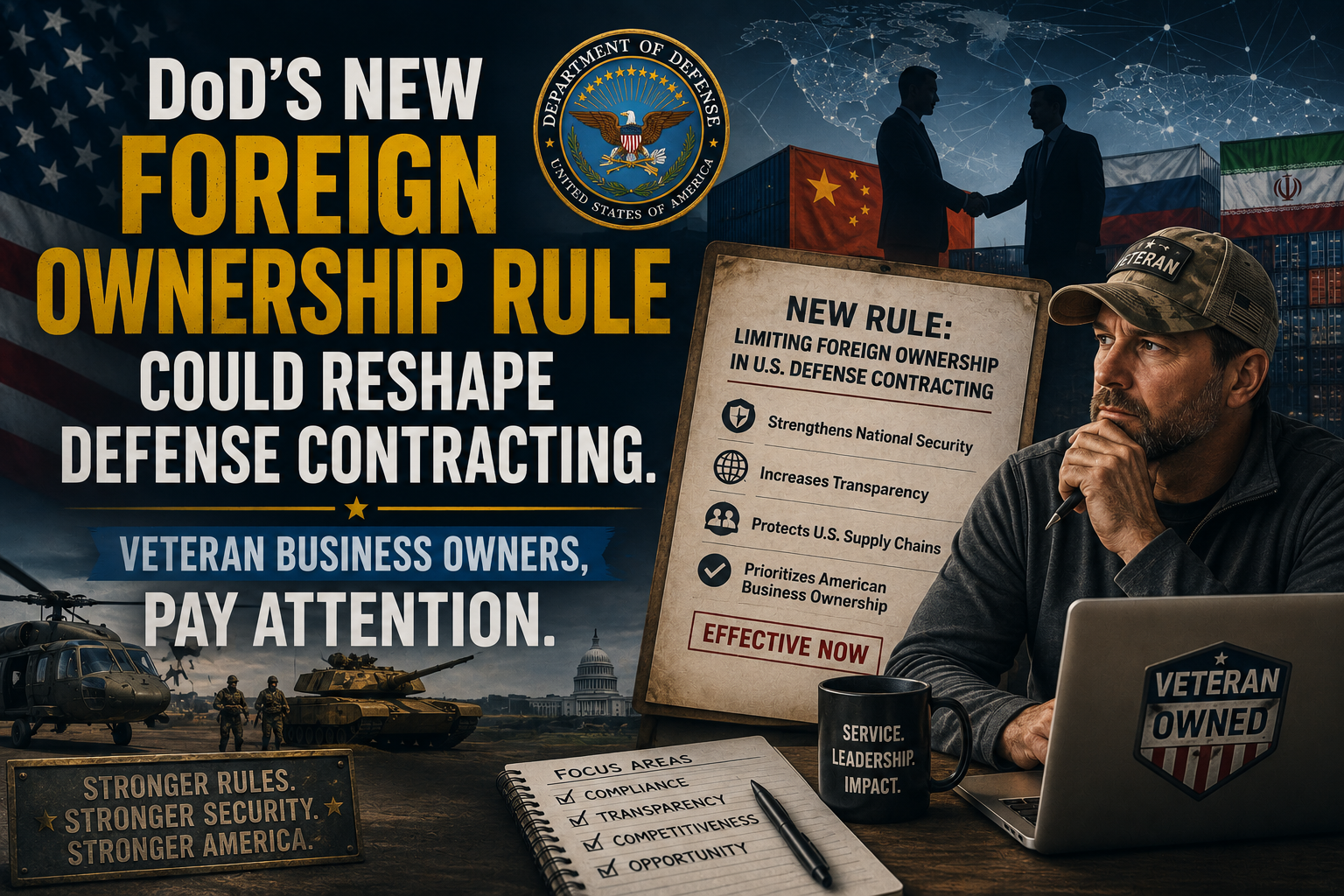
If you've transitioned out of the military and gone into defense contracting, or if you're running a veteran-owned business that does any work with the Pentagon, you need to put down whatever you're doing and read about the new DoD Foreign Ownership, Control, or Influence (FOCI) rule. It's not something you can clean up later — it's the kind of compliance requirement that can make or break a contract.
In May 2026, the Department of Defense proposed a sweeping new rule under the Defense Federal Acquisition Regulation Supplement (DFARS) that would require any contractor or subcontractor seeking DoD business to disclose their beneficial ownership information and whether they are subject to foreign influence. The rule applies to contracts valued over $5 million — and DoD estimates nearly 40,000 companies could ultimately be affected.
What FOCI Actually Means and Why DoD Cares
Foreign Ownership, Control, or Influence refers to any situation in which a foreign entity has the ability to affect the operations, management, or information of a company doing business with the U.S. government on sensitive programs. This could be through direct ownership, board representation, contractual obligations, or even financing arrangements with foreign entities.
The concern is real: adversarial nations — primarily China and Russia — have systematically sought to gain access to U.S. defense industrial base technology and data through commercial investment channels. A small veteran-owned cybersecurity firm with a minority foreign investor, for example, could unknowingly be a vector for intelligence collection on classified or sensitive DoD programs.
What the New Rule Requires
-
Contractors and subcontractors must disclose beneficial ownership information to the Defense Counterintelligence and Security Agency (DCSA).
-
Companies must report whether they are under any foreign ownership, control, or influence.
-
Disclosure must be updated throughout the life of any contract — this is an ongoing obligation, not a one-time checkbox.
-
FOCI risks must be mitigated within 90 days of identification.
-
The rule applies at the prime contractor AND subcontractor level — which means even small businesses that are subs to a large prime need to comply.
What This Means for Veteran-Owned Defense Businesses
The vast majority of veteran-owned small businesses doing DoD work have no foreign ownership issues whatsoever. For those companies, the rule creates a compliance burden but not an existential threat. For the small number that have foreign investors, joint venture partners, or international business relationships, this rule requires immediate legal review.
Here's the practical playbook:
-
If your company does or intends to do DoD contract work above the $5M threshold, conduct a beneficial ownership review with a qualified government contracts attorney now — before the rule finalizes.
-
Identify all foreign nationals with equity stakes, board seats, or management roles in your company.
-
Review all foreign business relationships — financing, licensing, teaming arrangements.
-
If you have a FOCI situation, mitigation options exist (Special Security Agreements, Board Resolutions, Proxy Agreements) — but they take time and legal expertise to implement.
-
Subscribe to DCSA's industry guidance updates — the implementing regulations will include compliance guidance.
The Opportunity Inside the Compliance Burden
Here's the thing about new regulatory requirements in the defense space: they create demand for people who understand them. Veterans with security clearances, program management experience, and an understanding of DoD contracting culture are exactly the kind of people that defense companies need to build compliance infrastructure.
If you're transitioning and looking for a civilian career lane, government contracts compliance — particularly in the security and FOCI space — is a growing field. Your clearance is a differentiator. Your understanding of how DoD systems work is a differentiator. This rule just expanded the market for your skills.
Join the Conversation
Are you a veteran entrepreneur or defense contractor navigating the new FOCI landscape? Share your questions and experiences. The veteran business community is strongest when it shares knowledge — drop your perspective below.