The soldier who wins the next war might be a 16-year-old sitting in a robotics club right now, nowhere near a recruiting station, who hasn't even considered military service.
That's not a problem. That's an opportunity — if the Army is smart enough to reach them before they default to a career they didn't choose.
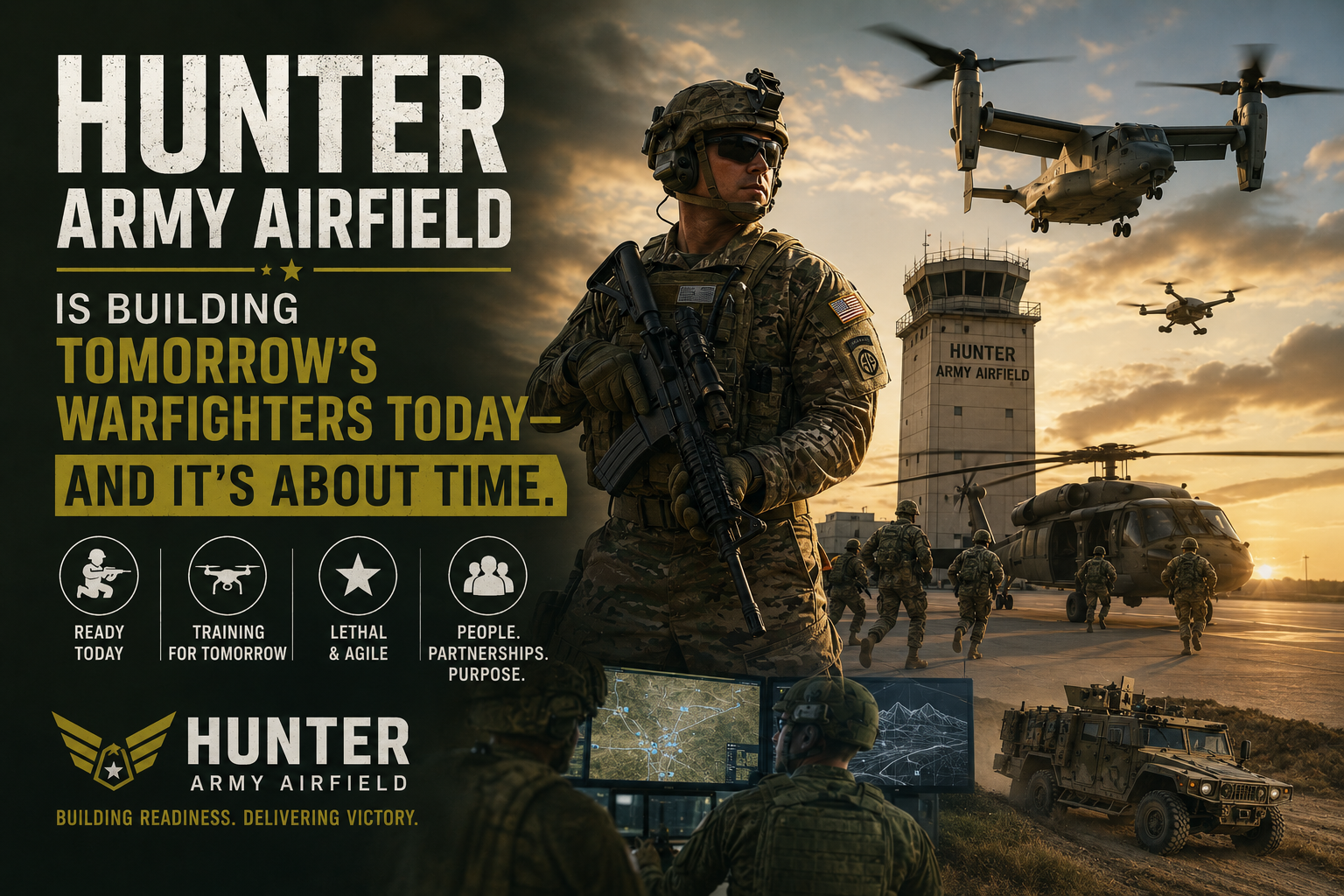
At Hunter Army Airfield this June, the 3rd Infantry Division's installation took a concrete step in exactly that direction.
What Happened — and Why It Matters
On June 3, 2026, Hunter Army Airfield hosted a Next Generation Innovators event aimed at sparking interest in military technology, STEM careers, and service among the next wave of American talent.
Events like this don't always make the front page. They should.
Here's the strategic reality: the Army is fighting two personnel challenges simultaneously. The first is a recruiting environment that has been difficult for years — a smaller percentage of America's youth meets enlistment standards, and an even smaller percentage is considering military service. The second is a modernization imperative — multi-domain operations, autonomous systems, artificial intelligence, electronic warfare — that demands technically sophisticated soldiers and officers at every echelon.
The solution to both problems starts before someone walks into a recruiter's office.
The 3rd Infantry Division's Innovation Push
Hunter Army Airfield isn't just hosting community events for optics. The 3rd Infantry Division — the Army's "Rock of the Marne" — has been actively adapting its doctrine and force structure to address what leadership calls congested and contested battlefield environments.
This is the real-world context for the innovation push: the battlefield of the near future looks nothing like the counterinsurgency fights of the last two decades. It looks like drone swarms, electronic jamming, satellite-denied navigation, and cyber intrusions layered over conventional maneuver. The soldiers who will fight in that environment need to be technically literate in ways that previous generations of infantrymen never had to be.
The Next Generation Innovators event plants seeds. A high school student who walks through an exhibit on autonomous systems, who handles a drone controller for the first time, who talks to a young lieutenant about her ROTC scholarship and her engineering degree — that student now has a mental picture of the Army that isn't just combat boots and push-ups. It's a technology organization that needs problem-solvers, engineers, and innovators wearing the uniform.
For Veterans in Tech: Your Service Is the Competitive Advantage
If you're a veteran who ETS'd and transitioned into the tech sector — software engineering, cybersecurity, data science, systems integration — the Army's innovation push creates an interesting opportunity.
Reserve and National Guard units increasingly need soldiers with exactly the technical backgrounds many post-9/11 veterans have developed in the civilian sector. Programs like the Army Reserve's Cyber and Information Operations units, Civil Affairs and Psychological Operations commands, and Signal and Intelligence branches are actively looking for soldiers who bring dual competency: military experience plus civilian technical expertise.
You don't have to choose between your tech career and your service. In 2026, the Army increasingly needs both at the same time.
For Young People Considering Service: The Army Is Not What the Recruiter Poster Says
Here's the honest pitch for the next generation:
The Army is one of the few organizations in the country where a 22-year-old can manage a multi-million-dollar equipment account, lead a team of 10 people, and be trusted with decisions that matter — before they've had their first civilian performance review.
It will be hard. You will be uncomfortable. You will be away from home. You will be asked to do things that don't come with a clear job description.
But you will also be part of something that most people spend their whole lives looking for: genuine purpose, genuine accountability, genuine community.
The Next Generation Innovators event at Hunter is one door. There are others. Find one that fits and walk through it.
The Bottom Line
The Army's greatest long-term readiness challenge isn't equipment or budget — it's people. And the solution to the people problem starts with showing the next generation what service actually looks like, what it demands, and what it builds in the people who choose it.
Hunter Army Airfield got that right. More installations should follow the model.
Did a Military Event or Mentor Influence Your Decision to Serve?
Tell us in the comments. Was there a moment — a base visit, a recruiter conversation, a family member in uniform — that made the difference? Your story might be exactly what someone on the fence needs to hear.
📢 Share this with a young person in your life who is talented, driven, and looking for a challenge worthy of their potential. And follow Mil Reporter for military career insights, veteran success stories, and Army modernization news.