There's a version of this conversation that sounds like a PowerPoint slide from a TRADOC modernization brief. Then there's the version that matters to you — the E-6 trying to figure out what your MOS looks like in five years, the captain wondering whether your branch will be affected, the veteran deciding whether to stay in a field that's changing fast or pivot to something else.
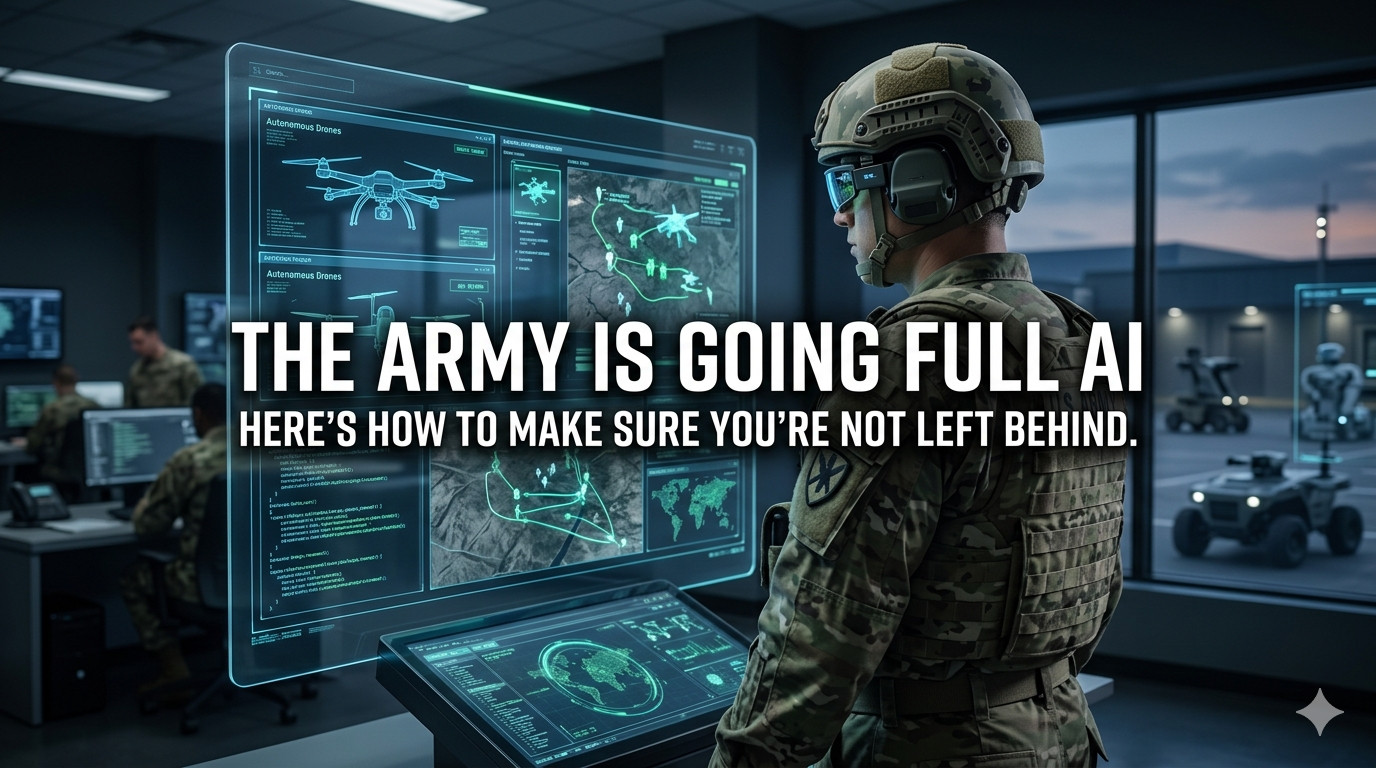
Let's do the second version. The Army is going all-in on artificial intelligence. Project ARIA (launched in March 2026), a new data operations center, an AI tabletop exercise for cyber defense, hyperscaled data centers negotiated with private industry, and a drone acquisition marketplace — all of this happened in the first five months of 2026 alone. This isn't a pilot program. This is a force transformation, and it's happening now.
What's Actually Changing
Project ARIA — Artificial intelligence Rapid Integration and Assurance — is the Army's framework for getting AI into operational use faster. It's designed to shortcut the traditional acquisition process for AI tools, getting capability to the field in months rather than years. The data operations center launched in April gives warfighters access to processed, analyzed data at a speed and scale that wasn't previously possible.
What does this look like at the unit level? Eventually: AI-assisted maintenance scheduling that predicts equipment failures before they happen. AI-powered intelligence analysis that flags patterns human analysts would miss. Logistics optimization that reduces the tail-to-tooth ratio. And increasingly, AI as a component of the targeting and decision-support chain.
MOSs Most Affected — And How to Prepare
-
Intelligence (35-series): AI is already augmenting intelligence analysis. The 35-series soldier who understands both the intelligence craft and how AI systems process information will be in extremely high demand.
-
Signal and Cyber (25/17-series): The data infrastructure underpinning AI requires soldiers who understand both the military network and the technical systems running on it.
-
Logistics (92-series): AI-driven supply chain optimization will change how 92-series soldiers work — those who adapt will lead the modernization; those who don't may find their roles automated.
-
Aviation (15-series): Autonomous and semi-autonomous aircraft are coming. Maintenance MOSs that understand both mechanical and software systems will be the most valuable.
-
Infantry and Armor (11/19-series): The maneuver force will increasingly rely on AI-enabled decision support at the squad and platoon level — leaders who understand the technology will make better decisions than those who just trust the output.
How to Build AI Literacy Without Going Back to School
You don't need a computer science degree to develop meaningful AI literacy. What you need is a foundational understanding of how these systems work, where they fail, and how to critically evaluate their outputs. Here's a practical approach:
-
Take Coursera or edX courses on AI fundamentals — many are free or low-cost and can be completed on your own time.
-
The Army's own AI Task Force has published primer materials. Find them and read them.
-
Volunteer for any unit-level AI pilot programs, evaluation teams, or technology demonstration events.
-
Connect with the Army Futures Command community — they publish accessible materials on modernization priorities.
-
For veterans: many defense contractors run internal AI training programs. Ask about them before you sign an offer.
The Human in the Loop — That's Still You
Here's the thing that gets lost in AI hype: the human judgment call — the leader who recognizes that the AI's recommendation doesn't account for the thing only someone who's been in that environment can know — that's still the most valuable thing in the system. AI makes better analysts and better logisticians. It doesn't replace the leader who looks at the output and says, 'something's wrong with this picture.'
Build your AI literacy. Understand the systems your units will rely on. But don't lose the operational judgment that comes from experience. That combination is what makes you irreplaceable.
Join the Conversation
Is your unit already using AI tools? Are you a veteran who's made the transition to a defense tech or AI-adjacent career? Share what you've learned — the community is figuring this out in real time, and practical experience is more valuable than any briefing.