Every soldier in the U.S. Army has sat through a SHARP brief. You know how it goes. PowerPoint slides. Required attendance. A box gets checked somewhere in a training management system. Formation is dismissed.
And then — if the command climate is right, if the leaders in that room actually believe in what they're briefing — something happens that a PowerPoint never could. A soldier asks a question they wouldn't have asked otherwise. A sergeant shares something they've been carrying. A victim reports.
That's the gap between a mandatory training requirement and an actual prevention culture. Fort Leavenworth's SHARP community decided to approach that gap differently.
What Happened at Fort Leavenworth
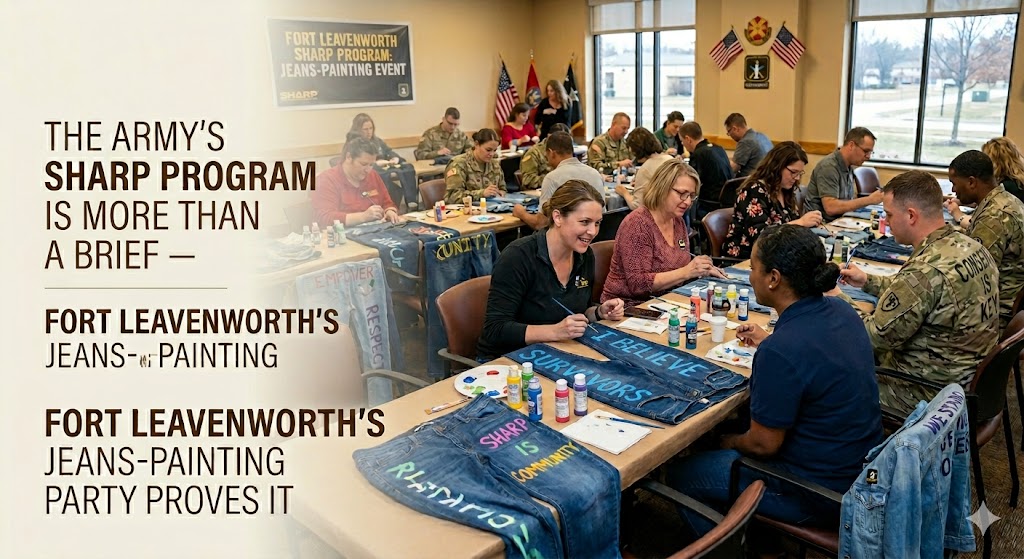
During Sexual Assault Awareness and Prevention Month (SAAPM), the SHARP community at Fort Leavenworth held a jeans-painting party — a creative, low-barrier event designed to get soldiers, family members, and civilians engaged with prevention messaging outside the traditional brief environment.
Participants painted denim with messages, artwork, and symbolism tied to SHARP awareness. The activity created space for conversation that doesn't happen when someone is staring at a slide in a mandatory training seat.
Is a jeans-painting party going to end sexual assault in the military? No. But here's what it does: it signals that SHARP isn't just a briefing requirement. It's a community value. It makes SHARP accessible to people who would tune out a PowerPoint and actually lean in to a low-pressure creative event. It builds the kind of relational trust between soldiers, SARC advocates, and unit leaders that makes someone more likely to call the hotline at 0200 on a Tuesday when they actually need it.
That's not a small thing.
The SHARP Problem the Army Still Hasn't Solved
Let's be honest about where the Army is on sexual assault prevention in 2026.
Progress has been real. The establishment of independent prosecution authority through the Uniform Code of Military Justice reforms — removing sexual assault cases from the chain of command — was a structural change that advocates fought for decades to achieve. Reporting rates have increased as trust in the system has — slowly, unevenly — grown.
But the culture problem persists.
Toxic leadership that creates permissive environments. Retaliation — formal and informal — against victims who report. The insular dynamics of small units where social pressure overrides individual accountability. These aren't problems that independent prosecution solves by itself. They require sustained culture change at the squad, platoon, and company level.
And culture change doesn't happen in a mandatory training brief. It happens in hundreds of small decisions made by leaders every day: how they respond when a soldier makes a joke that isn't funny. Whether they make time for a subordinate who asks to talk. Whether they treat SHARP as a compliance box or as a genuine leadership priority.
What Good SHARP Leadership Actually Looks Like
If you're a leader reading this — squad leader, platoon sergeant, company commander, first sergeant — here's the honest framework:
Prevention starts with your command climate. Not your SHARP brief frequency. Your climate. Do your soldiers believe that you will take a report seriously? Do they trust that coming forward won't cost them their career or their unit relationships? If the answer to either of those questions is "I'm not sure," that's where the work starts.
Your SARC is a resource, not a formality. Every installation has a Sexual Assault Response Coordinator. Do you know who yours is? Have you introduced them to your formation? Have your soldiers met them in a non-mandatory context — at a unit event, at a MWR activity — so that the SARC's face isn't just a slide in a brief?
Bystander intervention is a leadership skill. The most effective SHARP prevention isn't individual — it's collective. Soldiers who intervene when they see something wrong, who step in before an assault happens, are the front line of prevention. Teach bystander intervention the way you teach tactical tasks: through repetition, scenario, and feedback.
Events like Fort Leavenworth's jeans-painting party work because they lower the barrier. The best SHARP programming isn't the most intense. It's the most accessible. Events that meet soldiers and families where they are — casual, creative, community-based — normalize the conversation in ways that mandatory training cannot.
Resources Every Soldier and Family Member Should Know
If you or someone you know needs help:
- Safe Helpline (RAINN/DoD): 1-877-995-5247 — confidential, 24/7
- Safe HelpRoom: An anonymous online chat option at safehelpline.org
- Your installation SARC: Every installation has one. Your unit's chain of command or ACS office can connect you.
- Restricted vs. Unrestricted Reporting: You have a choice about how a report is filed. A restricted report allows you to access services without triggering a formal investigation. Know your options before you need them.
The Bottom Line
Fort Leavenworth's jeans-painting party is a small event in the context of the Army's overall SHARP program. But it represents the right instinct: that prevention culture is built through community, creativity, and consistent signals that this matters — not through annual check-the-box briefs.
If your installation has SHARP programming that's working, that's innovative, that's actually moving the needle on culture — share it. The Army learns from what works.
What's SHARP Culture Like at Your Installation?
Is your unit doing SHARP programming that goes beyond the mandatory brief? Have you seen a leader or a community event make a real difference?
Share your experience in the comments. The best ideas in this space come from the soldiers and leaders living it — not from policy documents.
Share this with a leader you respect who takes command climate seriously. And follow Mil Reporter for military community stories, leadership content, and honest coverage of the issues that shape life in the Army.